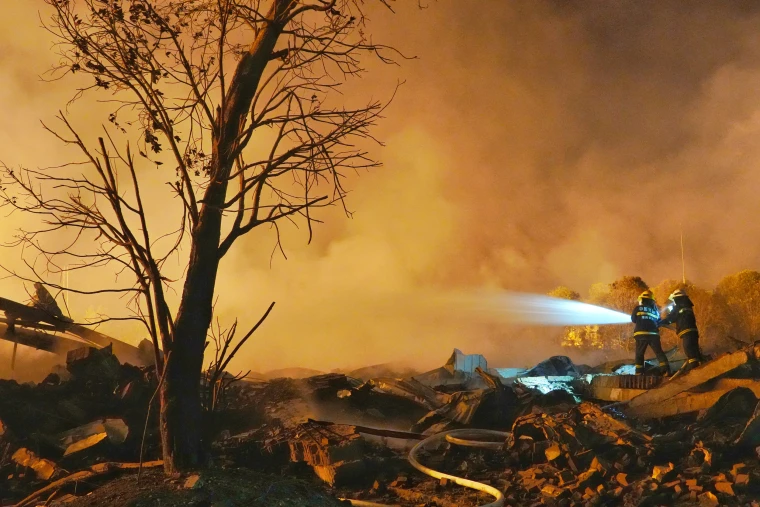
Early Jan. 3, the United States military carried out a large-scale strike on Caracas, Venezuela’s capital, leading to the capture of President Nicolás Maduro and his wife. This unprecedented operation, whose legality is being questioned on the national stage, occurred just under a month after the Trump Administration published their National Security Strategy. One might think that direct military intervention in a sovereign nation 1300 miles away from U.S. soil would be counterintuitive and even hypocritical in regards to this decidedly inward-focusing document. But upon closer inspection of President Trump’s Security Strategy, the strike on Venezuela and the capture of Maduro fall cleanly in line with the underlying framework that the Trump Administration has laid out.
According to its introduction, the National Security Strategy, which was published on the White House’s website, is driven by “two words, ‘America First.’” The Trump Administration essentially takes this phrase to mean that in order for the U.S. to remain prosperous and secure we must shift our hand of progress inward, focusing on improving various sectors and areas domestically instead of focusing on doing so in the rest of the world. They argue that since the end of the Cold War (or even before) we as a country have been focused on meeting the needs of other states with those states subsequently relying on us. Because of this dynamic, the document argues that our efforts have been too widely spread, and states that “to focus on everything is to focus on nothing.” The document condemns the last 34 or so years of focusing on “everything,” i.e. global peace and wellbeing, and declares that America’s efforts will shift in a domestic direction.
Later in the document, the Trump Administration outlines part of its foreign policy in a similarly domestic-shifting way with the heading “Predisposition to Non-Interventionism.” It cites the Declaration of Independence, saying that the United States shouldn’t intervene in the affairs of other nations because of “God-given rights” to “separate and equal station” for all states. This idea fits well with the “America First” line of reasoning: if the nation’s goal is truly to exclusively improve things on the home front, allocating resources and personnel to international intervention does not further this effort.
When solely examining the broad, intense strokes of language present in these two pieces of the National Security Strategy, a fairly coherent, if somewhat narcissistic and unnecessary foreign policy of semi-isolationism appears. How, then, is an attack on a sovereign nation’s capital and the removal of their leader, interventionism in its purist form, justified?
Below the introductions and headings of inward shifting focus and exclusive self improvement, the subtext of the document reveals a different administrative position. The Trump Administration repeatedly emphasizes internationally unchallenged military dominance and a sphere of influence spanning half the globe while contradicting its previous thesis of isolationism with the loopholes, double-backs and hypocrisy we have seen so frequently throughout the first year of its term.
For example, in the “Predisposition to Non-Interventionism” section, the administration immediately includes a caveat to their supposed respect of sovereignty of other nations, stating “for a country whose interests are not as numerous and diverse as ours, rigid adherence to non-interventionism is not possible.” By forgoing a definition of what qualifies another state’s interests as “numerous and diverse,” this subjective and murky benchmark leaves plenty of gray area for President Trump to justify intervention in a country like Venezuela, at least within the bounds of his foreign policy strategy.
Within the National Security Strategy, the Trump Administration also announced a “‘Trump Corollary’ to the Monroe Doctrine,” something they refer to as “common sense” in order to “restore American preeminence in the Western Hemisphere, and to protect our homeland and our access to key geographies throughout the region.” The Monroe Doctrine, put into effect by President James Monroe in 1823, declared the Western Hemisphere as a U.S. sphere of influence. Since then, several Presidents have introduced their own ‘corollary’s,’ most notably Theodore Roosevelt, in order to justify intervention in Latin American countries, similar to the recent attack on Venezuela. The Strategy goes on to say that the Corollary will be used to “assert ourselves confidently where and when we need to in the region,” once again leaving just enough intimidating gray area to outline and justify a wide range of actions in other states.
The section of the Strategy that truly served as a warning for intervention in Venezuela is the description of the ideal U.S. sphere of influence in the Western Hemisphere, “a Hemisphere whose governments cooperate with us against narco-terrorists, cartels, and other transnational criminal organizations.” In the eyes of the Trump Administration, Maduro is an alleged drug trafficker with ties to a cartel. Narco trafficking in Latin America is an issue President Trump has intensely cracked down on throughout his first and second terms. From his perspective, a prominent and oil-rich nation like Venezuela being run by a cartel member funneling drugs north directly threatens U.S. national security. It puts a blip in his sphere of influence while proving to him that Venezuela’s national interests are not “numerous and diverse,” whatever that might mean to him. Check and check; send out the helicopters.
The strike on Venezuela and the removal of Maduro are not the last U.S. intervention we will see in Latin America, or frankly the world, during the remainder of Trump’s presidency. The administration has declared that they will “run” Venezuela for the time being, presumably under justification of the Trump Corollary and other subjective, murky benchmarks for action. What is there to stop the Trump Administration from using these same justifications to pillage through the Western Hemisphere, taking what they want and instilling puppet leadership as they go? What systems are in place to stop this type of action in other global regions? In a recent interview, President Trump declared that the U.S. would take action on Greenland “whether they like it or not.” This entitlement to the riches of the world displayed by our president and his administration is profoundly dangerous. It pushes our allies away and pulls conflict closer. The Executive Branch is reckless, unchecked, and childlike, and their National Security Strategy foretells that things are going to get significantly worse before they get better.