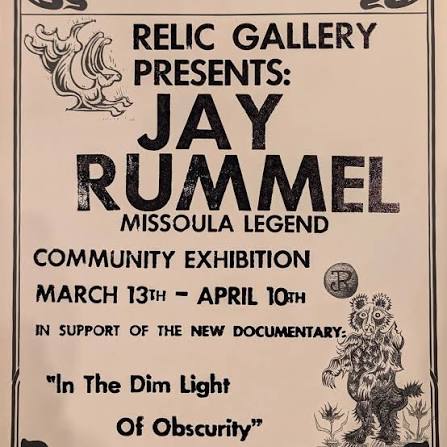
I didn’t expect to stay long when I walked into Relic Gallery downtown. I was just looking around when I noticed the artwork on the walls, lots of black and white prints, detailed and intense; , it is the kind of art that makes you stop instead of just glancing. It felt very historical, butalso rebellious, it was art that had something to say.
Then Brian Sippy walked up to me and started talking. It wasn’t robotic or rehearsed or formal. Instead he spoke quite quickly and passionately, very clearly excited to be sharing the story behind the art. He began telling me about Jay Rummel, an artist whose work helped shape Missoula’s creative culture but whose name has faded over time. “Jay tried to make sure people’s stories weren’t lost,” Brian said. “And now his story is getting lost.”
Sippy is a retired eye surgeon who stayed deeply involved in Missoula’s art community long after leaving medicine. In early 2020, he helped open a contemporary art gallery downtown. Six weeks later, the pandemic shut everything down. “We barely launched,” he said. “Then suddenly, nothing was happening.”
With extra space and time, Brian decided to do something different. He opened Relic Gallery, a space dedicated to heritage artists (artists who had passed away but whose works living artists are still building on). During the pandemic, as people sorted through old belongings, Sippy began finding artwork by Montana artists that had ended up out of state. “People were going through their grandma’s stuff,” he explained. “It was going onto eBay, and I had the opportunity to buy it and bring it back to Montana.”
That’s how he became deeply involved with Jay Rummel’s work. “I just loved his aesthetic,” Sippy said. “It was smart. It was a fusion of psychedelic culture, folk art, Native heritage, cowboy culture, just this huge amalgam of influences.” Over the course of the pandemic, Sippy restored and reframed dozens of Rummel’s pieces, treating them as fine art and reintroducing them to the Missoula community.
Jay Rummel was born in Helena and studied art in Missoula before spending years in San Francisco during the psychedelic movement. When he returned he brought those influences back with him. “He was a historian,” Brian said, “but he ran history through his own filter.” Rummel once referred to his work as “Mystical Histories,” a phrase that perfectly captures how his art blends fact, imagination, and symbolism.
Despite his immense talent, Rummel never found financial success. “This guy was probably one of the best artists in western Montana,” Zeiment, the director said, “and he’s trading his art for his beer tab.,” Zeimet added. Rummel struggled with alcoholism and died young, on December 31, 1997.
When I returned later to interview Brian, I unexpectedly met the director, Ben Zeiment, and the producer, Elizabeth Stegmaier of an upcoming documentary about Rummel. They told me that what began as a 12 to 15 minute short film quickly turned into something much bigger. “We realized pretty fast this story had legs,” Zeimet said. “It became a really intimate piece about Jay.”
The filmmakers have spent the past yearish interviewing more than 35 people, traveling to places Rummel lived, and uncovering archival footage from an unfinished documentary started in the early 1990s. “Someone had boxes of tapes sitting in their garage for 30 years,” Stegmaier said. “We didn’t even know that footage existed.”
The film doesn’t just focus on Rummel’s art. It also explores addiction, family fractures, and what it means to create without recognition. “He was an artist who couldn’t always get out of his own way,” Zeimet said, “but he made an incredible amount of work.”
What stood out to me the most throughout this experience was Sippy’s urgency. “You’re from here,” he said to me. “And his name isn’t off the top of your head, right? That’s the problem. It’s time to tell his story.”
Rummel lived in Missoula during a pivotal moment, when the town was shifting from a blue collar logging town into the creative, artistic community it is today. His art reflects that change and captures a version of Missoula that still shapes the city now. “This isn’t just Jay’s story, “ Brain said. “It’s Missoula’s story.”
When I walked out of the gallery I realized how rare it is to witness someone care so much and so deeply about preserving local history. Sometimes all it takes is an unexpected conversation to understand that art isn’t just something to look at, it’s how a community remembers itself.
The team working on this project are truly amazing and passionate people and I am very excited to see their documentary. Sippy’s gallery Relic will be featuring Rummel art until April 10th and I strongly recommend taking a look at his work and having a chat with Sippy.