When was the last time you were able to fully complete a task without stopping to check your phone or getting distracted by a different task on your never ending to-do list? Don’t worry, many people suffer from their short attention spans as well—not being able to get one simple project done without getting distracted by a notification or stopping to do a different project—but this is not your fault.
The root cause of this problem is the widespread use of digital devices. They provide constant stimulation, a constant bombardment of notifications and fast-paced content, overwhelming the brain. Whatever you are doing on your device is almost always interrupted by another notification from something completely different, drawing your focus to a new thought.
According to Chaitanya Bonda, a board-certified neurologist by American Board of Psychiatry and Neurology, cell phones provide constant information overload and multitasking demands, leading to higher stress levels and a rise in anxiety. The brain becomes used to constant information shifts and distractions, lowering your attention span, and your brain becomes conditioned to seek instant gratification from digital stimuli.
It’s not your fault you are so connected to your phone either. Phones are used for almost everything nowadays. One cannot cut themselves off from technology entirely to fix this addiction because we rely so heavily on it. Checking the time, booking appointments, setting reminders, checking the weather, getting directions, buying tickets, shopping online, news updates, communication for work, communication for school, staying connected with friends and family, it’s never ending.
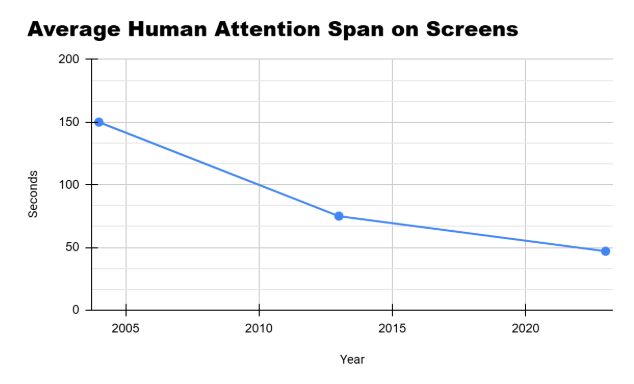
According to CNN Health, the average attention span on a screen was two and a half minutes in 2004. In 2013 it decreased to one minute and 15 seconds, and in 2023 it was down to 47 seconds. The decrease first happened just around the time the iPhone was introduced in 2007.
Cell phone use crosses the line to addiction when you are using your phone for more than what is needed, mindlessly scrolling or gaming for hours, not being able to go a couple minutes without checking up on notifications. A big reason for why people feel so connected to their phones in this way today is how they were raised as a child.
According to Dr. Gloria Mark in a Speaking of Psychology podcast with Kim Mills called “Why Our Attention Spans are Shrinking,” children from two to four years old already average around 2.5 hours of screen time a day, and children five to eight average around 3 hours of screen time a day. Many parents use TV, YouTube, or digital games to entertain their children, and many schools use online learning resources for education, causing the hours to accumulate quickly.
The reason this is such a big problem is because young children are more susceptible to distraction, taking them longer to get back to things they were distracted from. As said in Dr. Mark’s podcast, “I find it problematic that we’re putting children into a digital world before some very critical mental functions are fully developed. I don’t think kids are really ready for that.” Kids don’t yet have the ability of self control, decision-making, or setting priorities which all are necessary life skills.
Another cause for the ever shrinking attention span is multitasking, the idea of doing two tasks at once for quicker productivity. In reality, multitasking is really just switching your attention from different tasks quickly, which creates very high amounts of stress and a rise in blood pressure according to Dr. Mark. Every time you switch your attention, you have to reorient to that new activity that you are now paying attention to, and it takes some time. Mark calls this “switch costs.” This uses more effort and more mental resources, leading to lower performance, more mistakes, and exhausts the brain. After much practice, it reduces your brain’s capacity for deep focus.
However, it is also very important to take breaks while working to avoid getting burned out. The trick is making sure the breaks are meaningful. Instead of jumping straight onto your phone, finding millions of other distractions and overwhelming your brain with more information, stand up, take a walk, eat a healthy snack, recharge your body. The timing of your break is also important. Don’t stop working right in the middle of a task, as it will take way more mental resources to get back into what you were working on later. Instead, find a time when a break makes sense, and when you come back to your task, it will be easy to pick up where you left off, using minimal brain effort.
According to Healthline, a digital health and wellness platform with medically reviewed content, some of the problems that come with short attention span include poor performance in school or work, the inability to complete daily tasks, missing important details or information, communication difficulties in relationships, and poor health from neglecting healthy habits.
However, Healthline has found ways to improve your focus and improve your overall attention span. Chewing gum has been found to increase alertness and lower stress levels. Drinking water improves your ability to focus, as dehydration can lead to brain and body fatigue. Exercise improves your attention by increasing blood flow to the brain. Meditation trains the mind to stay present by reducing distractions.
Short attention spans can affect many things in everyday life, but you are able to build it back. Start limiting distractions and start resisting the urge to doom scroll when you’re overwhelmed. Give your brain meaningful breaks, let it recharge away from screens, and see what changes this will make on your mental and physical health.